Grounded in a commitment to human-centered design, I optimize user experiences not just for usability, but as a conduit for empathy-driven innovation.Drawing from my extensive background in non-profits and government mental health sectors, I am dedicated to pushing design boundaries and empowering users through transformative experiences. By aligning operational processes with user-centric principles, I ensure every interaction—digital, physical, or interpersonal—fosters seamless engagement and meaningful connections.
I spent the first part of my career working inside the kinds of systems I now help design—mental health services, child welfare, community support, and local government. I learned how much a person's experience can depend on things they never see: a policy, a form, a handoff between departments, or a decision made somewhere else.
That experience still shapes how I approach design. I begin by listening to the people who use a service and the people responsible for delivering it. I follow the work across teams, processes, and technologies, looking for the places where things connect, break down, or become unnecessarily difficult.
My approach isn't a fixed sequence of steps. Research, observation, mapping, prototyping, and testing help me make complicated systems visible. The goal isn't simply to create a better interface. It's to help people understand what's happening, question assumptions, and make better decisions together.
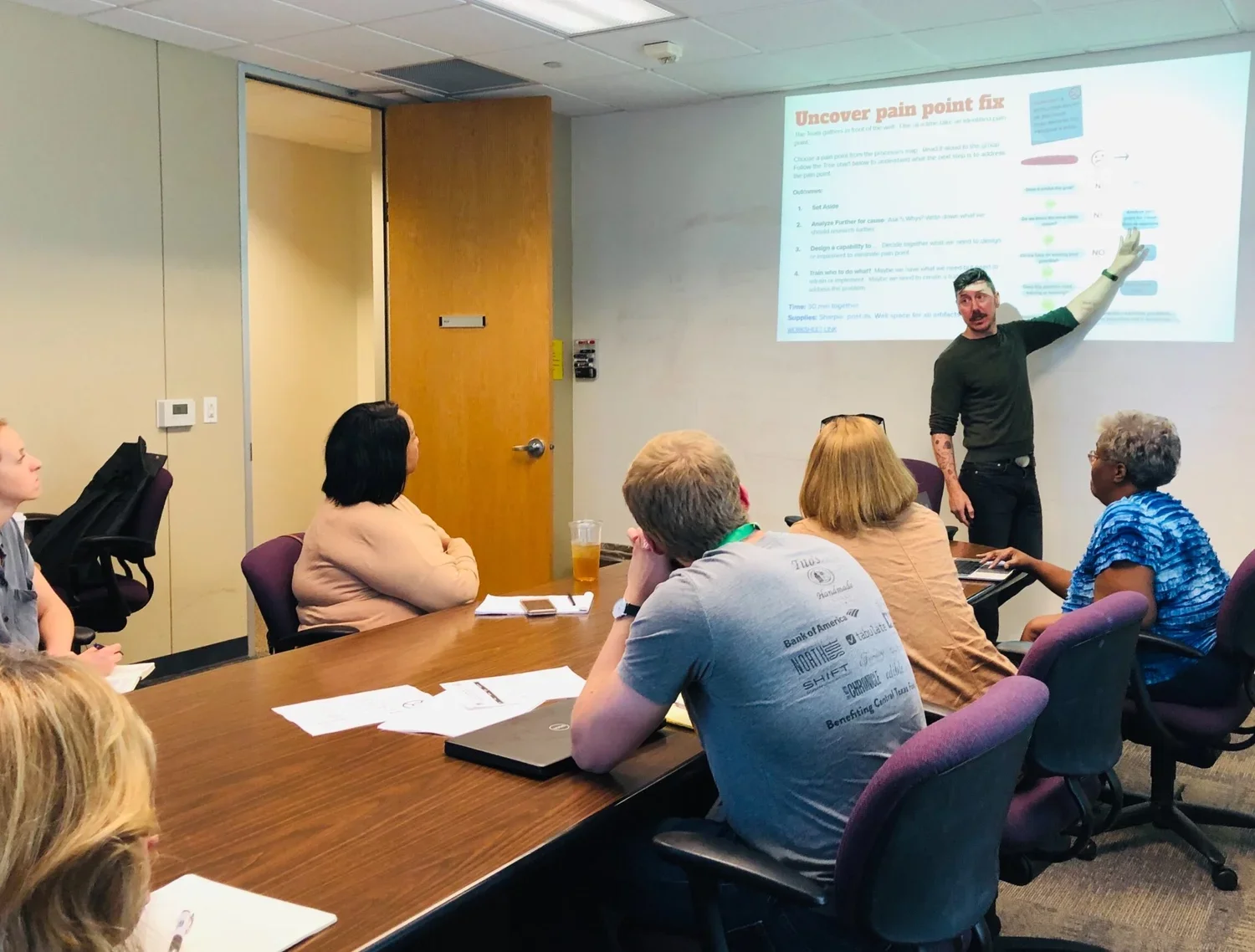
Design happens with people.
Facilitating a collaborative workshop
Notes from the Process
A few pages from my notebook—observations, questions, sketches, and ideas collected along the way. Some organized, some not. A glimpse into how I think through problems before they become polished diagrams and presentations.
Make the system visible. Then help the team make the next good decision.


The sketches and notes are only part of the story. The real work happens with people—asking questions, challenging assumptions, connecting the pieces, and finding ways to make complicated systems work better.
Make the system visible. Then help the team make the next good decision.