ABOUT
I came to design through people, not products.
My path into design wasn't a straight line. I began in clinical psychology and human services, working with people navigating circumstances that rarely fit neatly into the systems meant to support them. Those experiences taught me to look beyond policies, processes, and programs to understand what life looks like for the people on the other side.
That curiosity eventually led me into UX research, service design, and experience strategy. I've worked across government, technology, education, and community services, but the questions that drive me haven't changed much: How do people experience the systems around them? Where do those systems create unnecessary barriers? And what could we do differently?
Outside of my professional work, I'm also drawn to writing, art, and exploring ideas that bring people and communities together. I don't see these interests as separate from design. They're different expressions of the same curiosity about people, possibility, and how we shape the world around us.
What Shaped My Perspective
I was asking design questions long before I knew to call them design questions.
Some of my earliest lessons in understanding systems came from working in mental health and homelessness services in Seattle.
At Downtown Emergency Service Center (DESC), I worked directly with people navigating housing instability, behavioral health challenges, and public services that weren't always designed around their circumstances.
One experience involved Oscar, a man whose ability to maintain his independence depended on something as ordinary as riding the bus. Helping him regain access to transportation taught me how a seemingly small intervention could change someone's relationship with a much larger system.
I also participated in research connected to DESC's 1811 Eastlake supportive housing program, where housing, harm reduction, and evidence challenged conventional assumptions about how services should operate.
These experiences helped shape the perspective I bring to design today: look beyond individual behavior, understand the conditions surrounding it, and consider what the system itself needs to do differently.
EXPLORE MY EARLY WORK & RESEARCH →
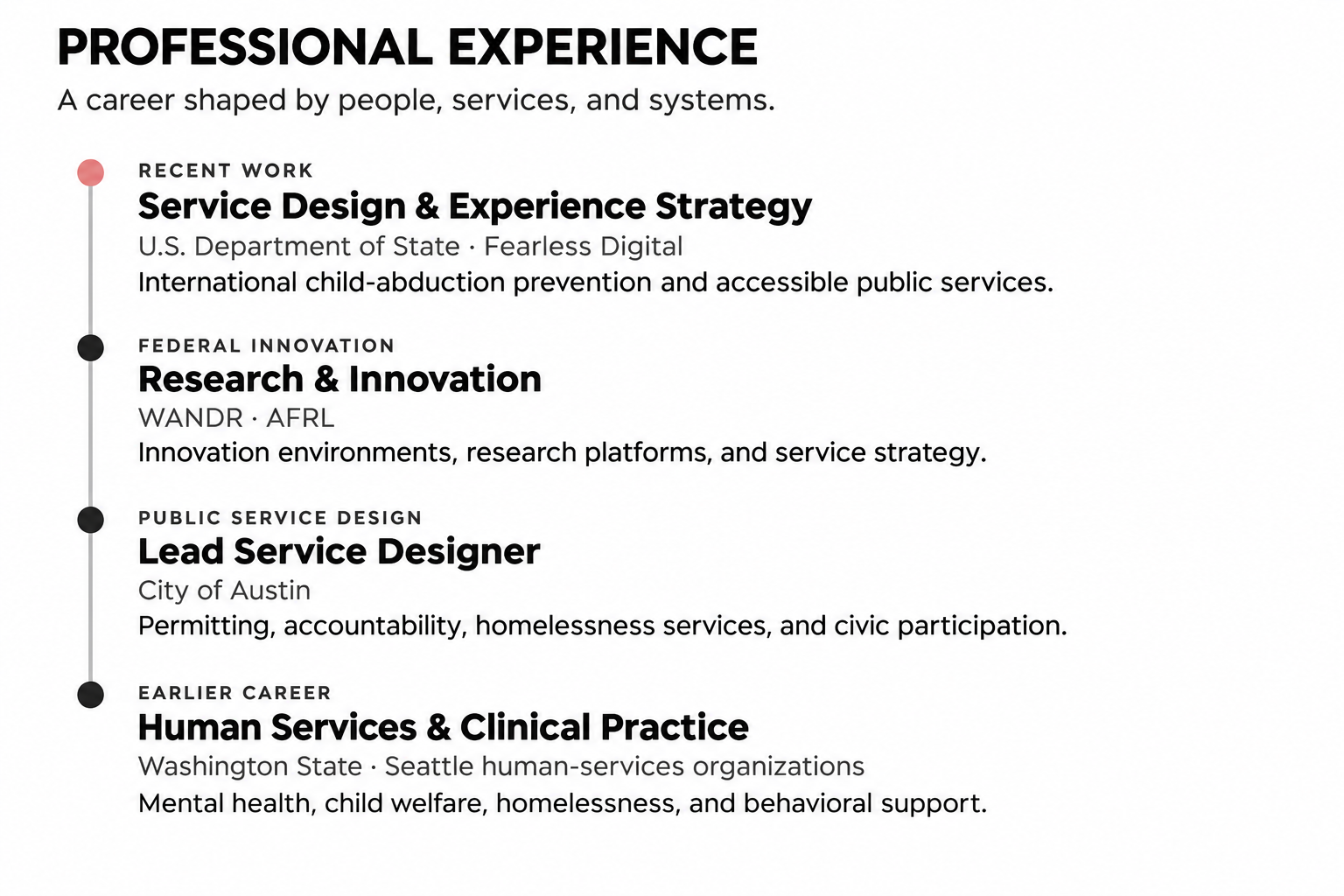
An Unconventional Path
Different disciplines. Different organizations. A consistent curiosity about people and systems.
My career has moved through clinical psychology, human services, technology, civic innovation, and government service design. What might look like a series of career changes has felt more like an evolving way of asking the same questions.
Each chapter has added something to how I work today: listening closely to people, understanding the environments shaping their experiences, making complicated systems visible, and helping teams find practical ways forward.
I didn't leave my earlier work behind when I became a designer. I brought it with me.
Education & Training
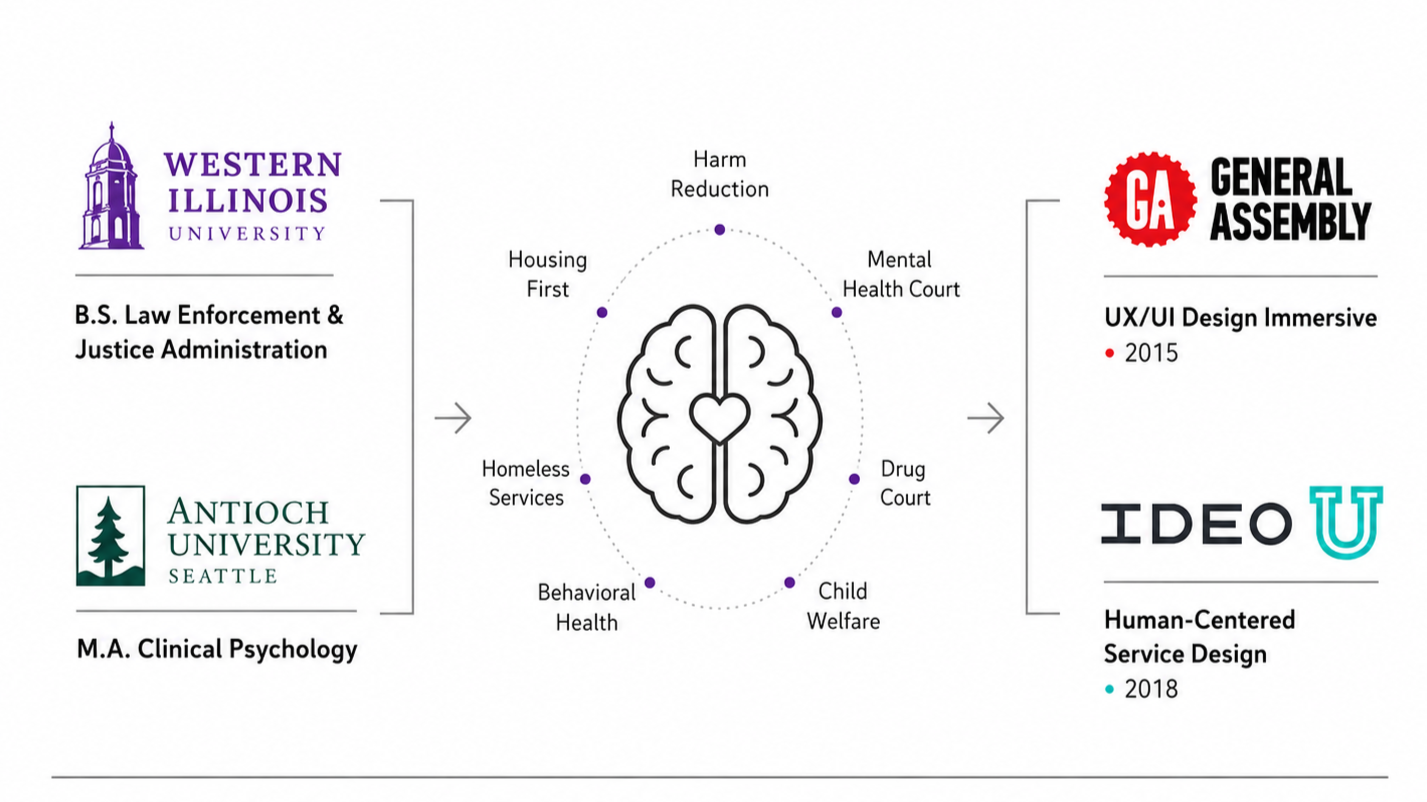
From understanding human behavior to designing human-centered services.
My education in psychology and justice administration provided a foundation for understanding people, institutions, and the systems shaping their lives.
Years of working in mental health, child welfare, homelessness, and behavioral health brought those ideas into practice. Later, formal training in UX design and human-centered service design gave me new methods for researching, mapping, and improving the systems I'd spent years working within.
These experiences continue to inform how I approach complex challenges: combining an understanding of human behavior with research, collaboration, and systems thinking.
What I'm Building Now
Taking what I've learned and putting it to work in new ways.
After years of working within government agencies, nonprofits, and technology organizations, I’ve become increasingly interested in what it means to build services and tools independently. That curiosity led me to establish Civic Service Studio, an emerging independent practice bringing together service design, research, and practical approaches to improving public systems.
One of the projects I’m developing is Community Garden Navigator, a tool intended to help people navigate the often complicated process of starting or joining a community garden. It grew from my earlier work with the City of Austin, where I saw how administrative complexity could get in the way of something as fundamentally human as growing food and building community.
I’m also continuing to write, explore new ideas, and think about how design can support stronger communities and more responsive institutions. For me, this work isn’t a departure from what came before. It’s a way of building on it.

Community Garden Navigator
An independent project exploring how to make starting and joining community gardens easier, more understandable, and more collaborative.
Let's Connect
I'm always interested in thoughtful conversations about people, public services, research, and making complicated systems work better. If something here resonates with you, I'd welcome a conversation.