U.S. DEPARTMENT OF STATE / SERVICE DESIGN & UX RESEARCH
Overseas Citizen Services
Research, content strategy, and experience design across critical consular services.
When U.S. citizens face difficult situations abroad, finding clear, trustworthy information and understanding what to do next can be essential. The services supporting them must work across complex policies, digital systems, and a global network of U.S. embassies and consulates.
Working with the U.S. Department of State's Office of Overseas Citizens Services (OCS), I contributed to research and design initiatives focused on making consular information more accessible, understandable, and responsive to the needs of citizens and the employees supporting them.
The engagement brought together four related areas of work: improving international parental child abduction prevention content, developing and researching digital content prototypes, evaluating existing templates through content and analytics research, and examining service needs across overseas missions.
Together, these efforts explored how clearer information, evidence-informed design, and a better understanding of service delivery could support people navigating complex and sometimes highly sensitive circumstances.
My Role: Service Designer
Focus: Service Design, UX Research, Content Strategy & Experience Strategy
Partner: U.S. Department of State — Office of Overseas Citizens Services
Engagement: Contract work through Fearless Digital
Scope of the Engagement
Four connected workstreams examining the public experience and the systems supporting consular services
My work with Overseas Citizen Services spanned four related initiatives. Three focused on improving information and support for families navigating international parental child abduction prevention, while the fourth examined how employees across overseas missions experienced the operational systems behind consular services.
Together, these initiatives brought information architecture, content strategy, UX research, analytics, and operational research into a broader effort to understand and improve service delivery.
The work connected two important perspectives: what people need when seeking government assistance, and what employees need to deliver that assistance effectively.
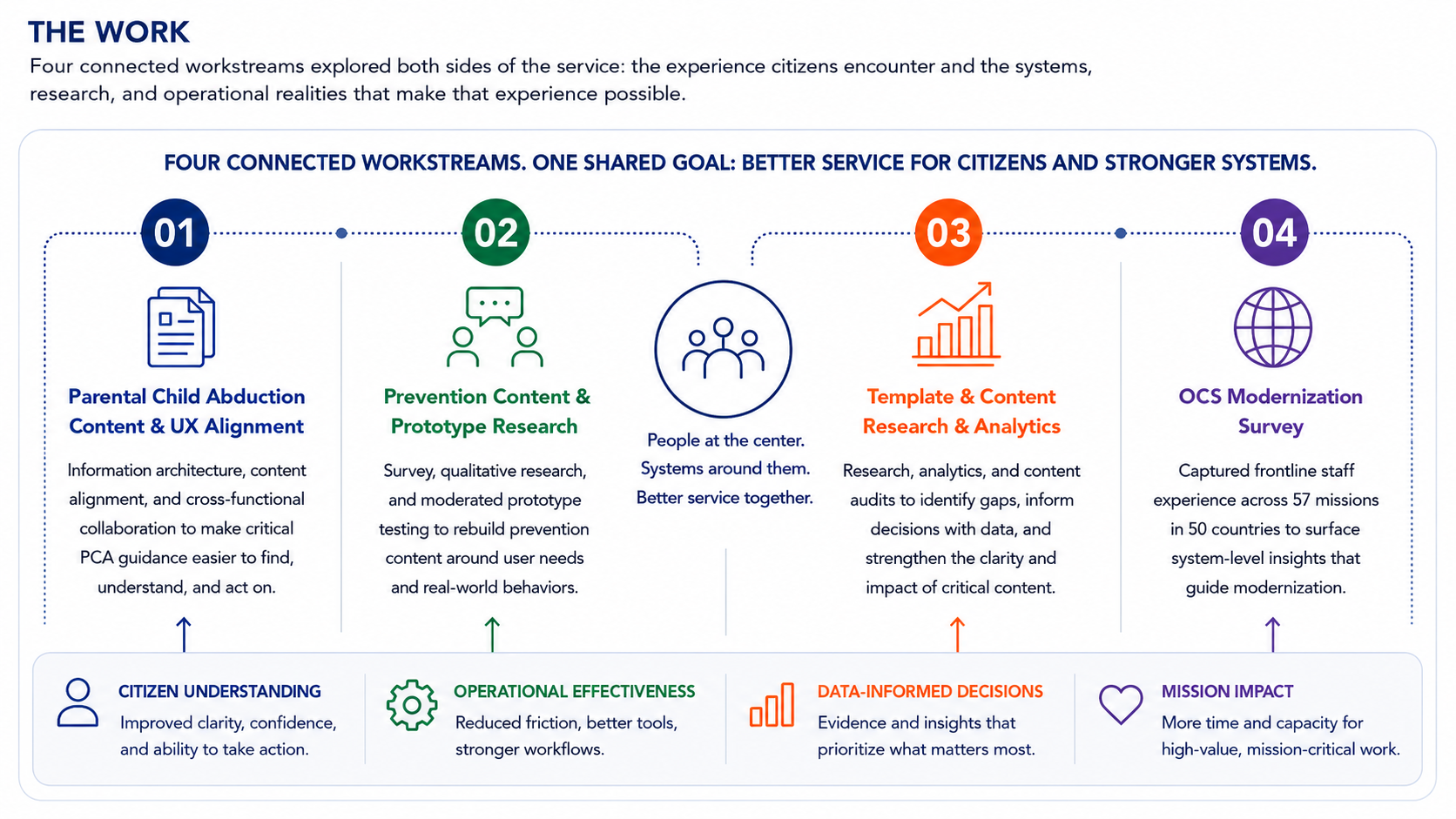
Four connected workstreams and their intended contributions to citizen understanding, operational effectiveness, data-informed decisions, and mission support.
Parental Child Abduction Content & UX Alignment
Reorganizing critical government guidance around the needs of families
International parental child abduction prevention involves complex legal information, emotionally sensitive circumstances, and situations where timely guidance can be essential.
Working with the Office of Children's Issues, I supported a UX and content review of Travel.State.Gov's parental child abduction information. The work examined how people found guidance, understood their options, and identified appropriate next steps.
Organizing Around Real-World Situations
One of the central design decisions was to organize the experience around three distinct situations:
Preventing Abduction — Understanding risks and taking preventive action.
Abduction in Progress — Finding immediate guidance when a child may be taken abroad.
Abduction Has Occurred — Understanding available resources and possible next steps.
This approach shifted the information architecture away from internal program organization and toward the circumstances families were navigating.
Rather than treating these situations as a fixed sequence, we explored flexible navigation that would allow people to move between them according to their needs.
Aligning Content, Navigation, and Measurement
The work also examined content hierarchy, accessible and mobile-friendly navigation, clearer calls to action, and ways to reduce unnecessary complexity in emotionally demanding situations.
Working across content, UX, and analytics, I helped develop recommendations for connecting the revised experience with behavioral measurement—including navigation patterns, search behavior, and engagement with important information.
These efforts established a foundation for clearer, more actionable content and future research to evaluate whether the proposed changes helped families find and understand the guidance they needed.
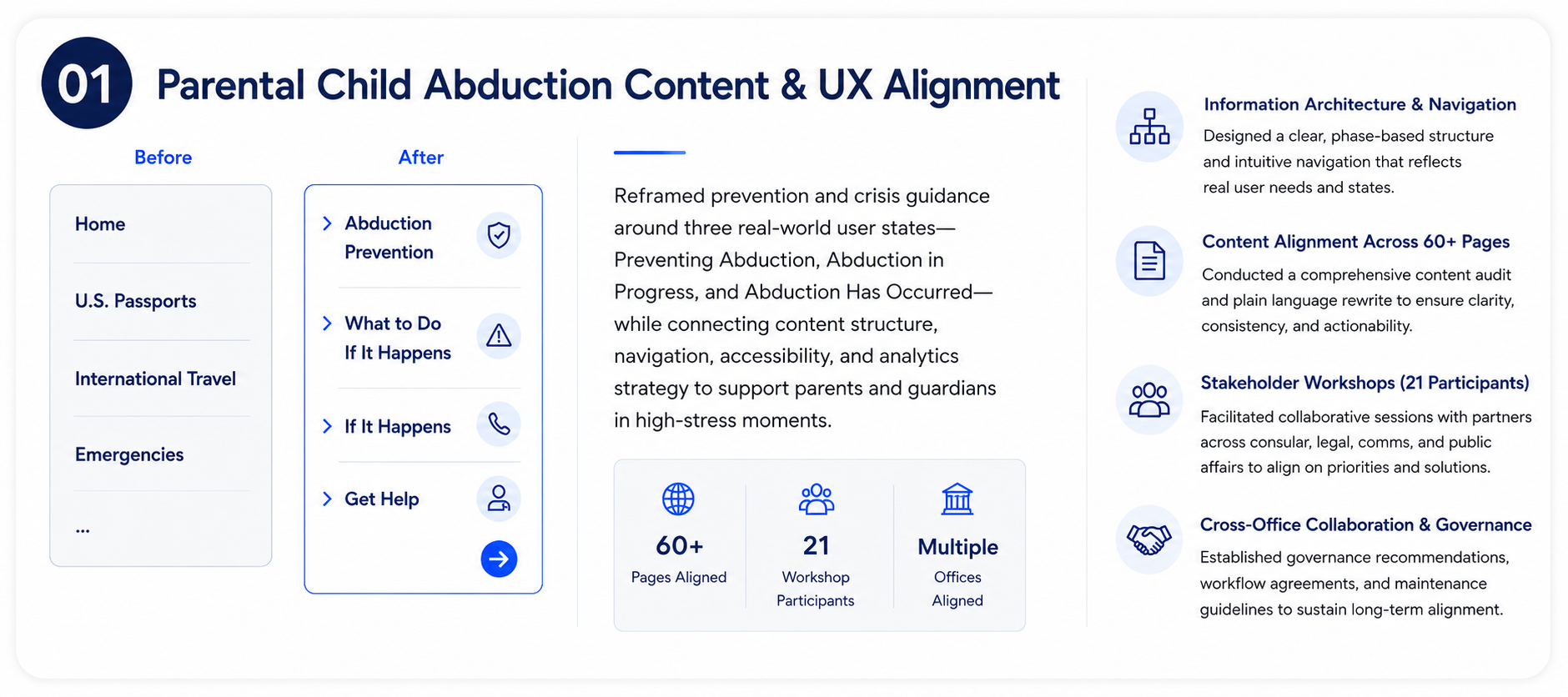
Information architecture concepts showing a shift from broad government navigation toward guidance organized around families' circumstances and immediate needs.
Prevention Content & Prototype Research
Preparing critical child-abduction prevention guidance for research with parents and guardians
Building on the initial content and UX alignment work, I helped review and document the redesigned Prevention experience across nine connected pages on Travel.State.Gov.
The work examined whether families could find relevant information, understand complex legal guidance, and identify appropriate next steps. Particular attention was given to plain language, content hierarchy, navigation, tone, accessibility, and the emotional circumstances in which people might encounter the information.
From Content Review to Research-Ready Design
The content review documented the purpose, audience, and structural changes across nine Prevention pages, including guidance on preventing abduction, the Children's Passport Issuance Alert Program (CPIAP), local law enforcement, emergency situations, and resources for parents.
Building on these changes, I developed a research framework to evaluate how parents and guardians would navigate the revised experience.
The proposed moderated study included three stages:
Warm-Up & Contextual Questions: Understand participants' expectations, previous experiences, and familiarity with government prevention information.
Think-Aloud Prototype Walkthrough: Observe how participants navigate realistic scenarios, interpret information, and identify appropriate actions.
Wrap-Up & Reflection: Explore perceptions of clarity, usefulness, trust, tone, and the overall experience.
Research tasks were connected directly to content and information-architecture decisions, helping the team identify not only where participants might struggle, but why.
Designing a Trauma-Informed Research Approach
Because the subject involved child safety and potentially distressing family circumstances, the research approach required more than conventional usability testing.
I consolidated existing research materials into a unified Parent/Guardian Moderator Guide, incorporating consent procedures, supportive moderator language, sensitive-scenario warnings, emotional check-ins, and opportunities for participants to maintain control over their experience.
The guide also included page-specific validation questions and observation prompts to help researchers assess navigation, comprehension, hesitation, emotional responses, trust, and understanding of next steps.
The research protocol was adapted for moderated sessions through UserTesting Live Conversations, establishing a consistent structure for moderators and notetakers.
What the Work Produced
The engagement produced a documented content review, a structured prototype research plan, scenario-based tasks, validation questions, an observation framework, and an integrated moderator guide.
These deliverables established a foundation for future usability testing and iteration. The research framework was prepared for validation; the findings from that testing were not part of this documented phase.
The underlying goal was to ensure that clearer content and navigation could ultimately be evaluated against what mattered most: whether parents and guardians could understand their options and know what to do next.
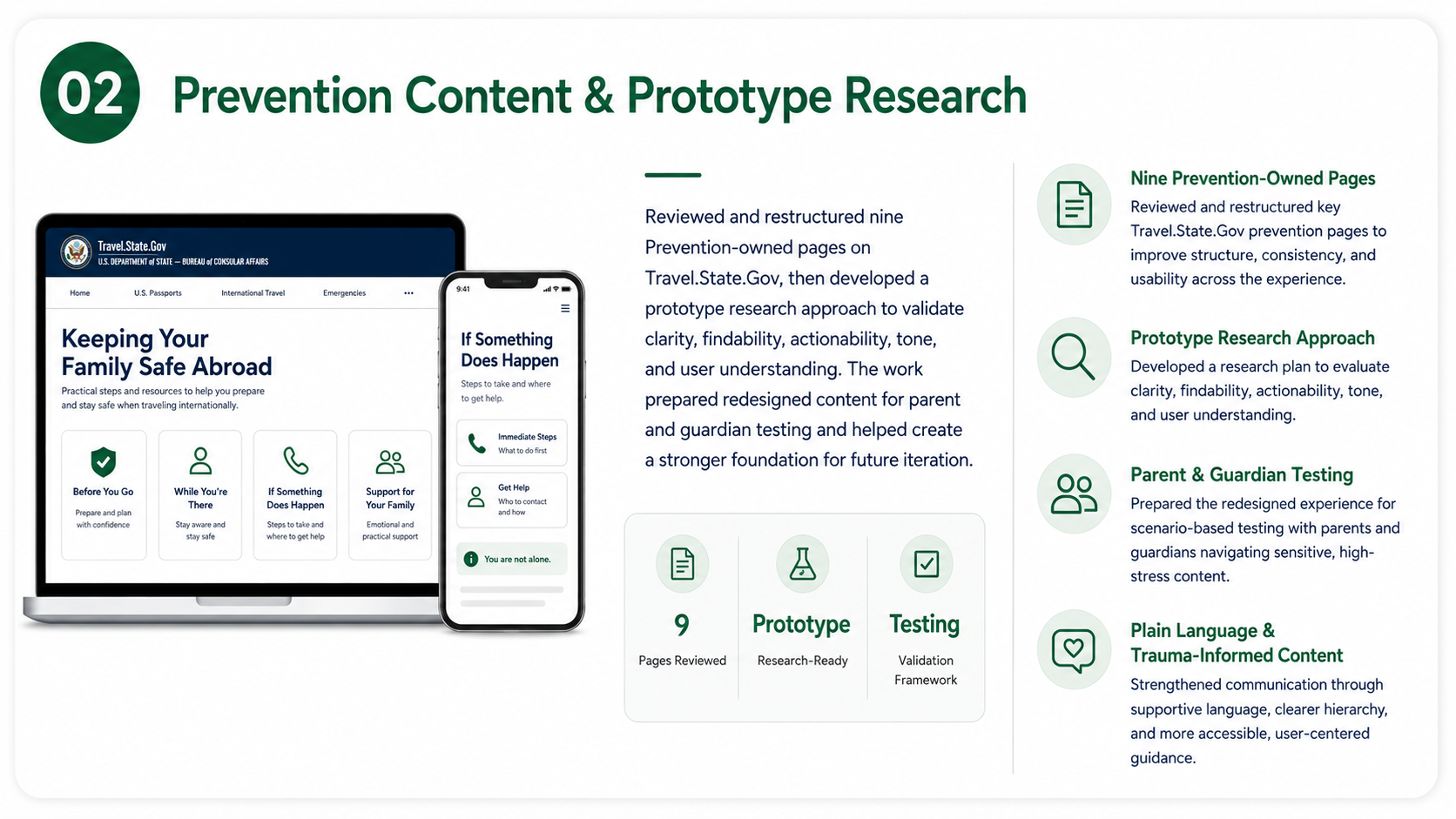
Prevention content review and prototype research planning, showing completed design activities, proposed validation steps, and guiding principles.
Template & Content Research & Analytics
Using content research and behavioral data to identify gaps and prioritize improvements
Alongside the UX and prototype research, I supported a content and analytics review of international parental child abduction prevention information. The work combined an audit of 16 CPIAP-related templates with analysis of more than two million pageviews across prevention content.
The goal was to understand how existing information supported users, identify inconsistencies and barriers to comprehension, and establish evidence-informed priorities for improvement.
Auditing Content for Clarity and Consistency
We reviewed 16 templates spanning alerts and notifications, guides and resources, procedures, and communications.
The audit examined content clarity, consistency, tone, readability, and plain-language effectiveness. Particular attention was given to whether important information was understandable, accessible, and actionable for people navigating potentially stressful circumstances.
Findings were organized into three priority levels:
6 high-priority templates
6 medium-priority templates
4 low-priority templates
This provided a structured way to identify where revisions should receive the greatest attention.
Connecting Content Research with Analytics
We also examined more than two million pageviews to understand how people encountered and engaged with prevention information.
By considering usage patterns alongside the content audit, we could identify opportunities for further investigation, examine potential gaps in the user journey, and inform decisions about content organization and refinement.
Bringing these sources of evidence together helped move the recommendations beyond editorial preferences toward a more systematic approach to content improvement.
What the Work Produced
The work resulted in a prioritized content audit, plain-language and content-style findings, analytics-informed recommendations, and a clearer set of opportunities for improving prevention information.
These findings provided a foundation for subsequent content decisions and evaluation, without assuming that recommended changes had already been implemented or validated.
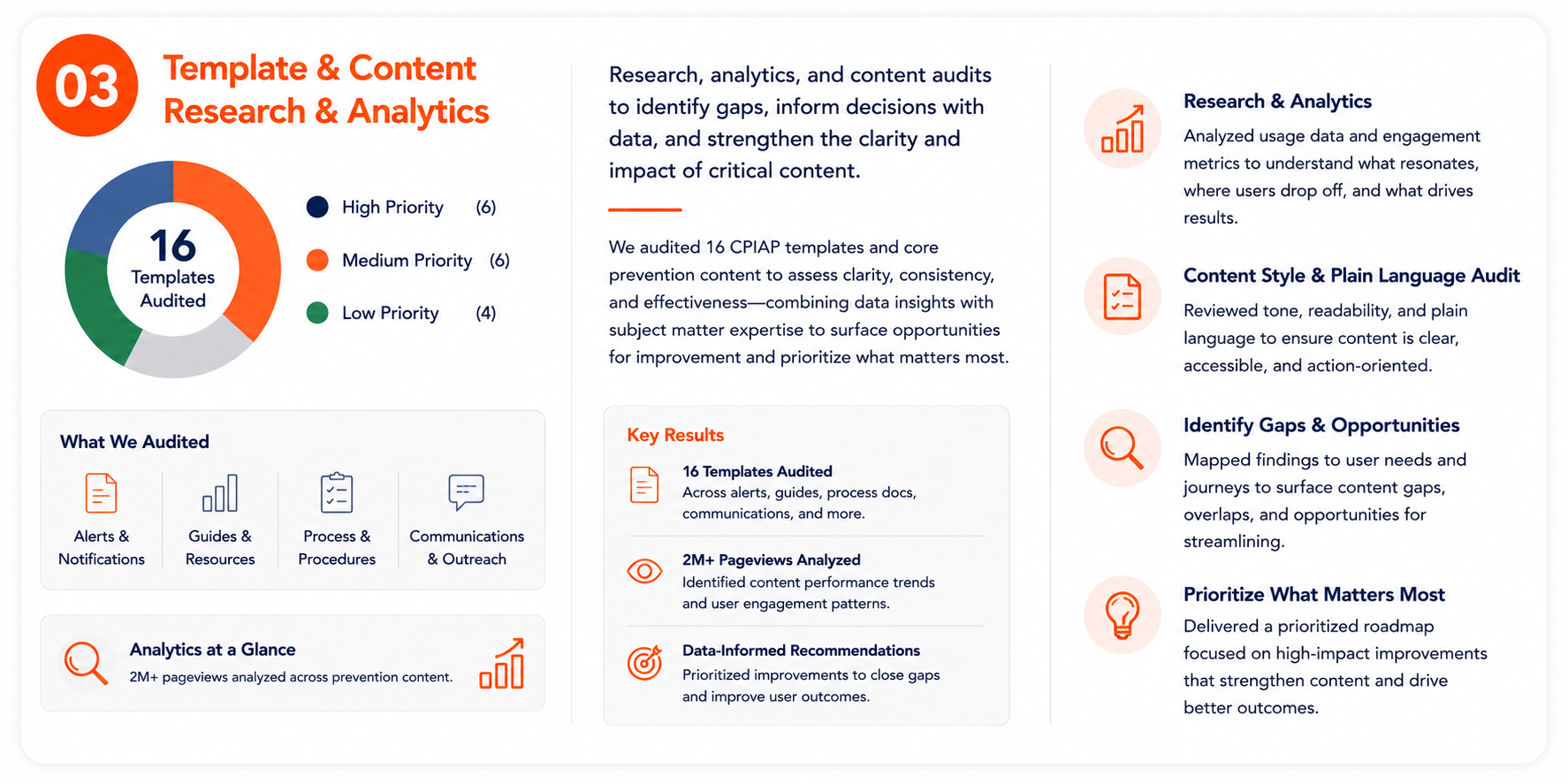
Content and analytics research across 16 CPIAP templates and more than two million prevention-content pageviews, informing priorities for clearer, more consistent guidance.
OCS Modernization Survey
Turning frontline employee experience into evidence for service modernization
While the earlier workstreams focused primarily on public-facing information, this initiative examined the systems and operational conditions behind consular service delivery.
Overseas Citizen Services operates through a global network of U.S. embassies and consulates. Employees navigate policies, technology, administrative requirements, and local operating conditions while supporting citizens, often in urgent or sensitive situations.
Working with the Bureau of Consular Affairs Customer Experience Team, I helped develop an analytical approach to understand these experiences and translate frontline feedback into actionable modernization insights.
Understanding the Global Service Experience
The research drew on a 13-question staff survey that gathered:
135 responses
57 overseas missions
50 countries
Rather than evaluating individual employee performance, the research focused on the conditions shaping service delivery: how staff spent their time, where processes created friction, and where local innovations might offer opportunities for broader improvement.
Building a Four-Pillar Research Framework
We organized the survey into four analytical areas:
Mission & Value Alignment — Understanding which activities staff considered most meaningful and how their work connected to the mission of citizen protection.
How Time Is Actually Spent — Examining administrative responsibilities, routine tasks, and the activities consuming employee capacity.
Service Delivery & Operational Gaps — Identifying workflow inefficiencies, technology limitations, approval bottlenecks, and challenges affecting service delivery.
Change Readiness & Field Innovation — Exploring staff-created solutions, local adaptations, and opportunities to strengthen systems across missions.
The framework provided a consistent structure for interpreting open-ended responses while preserving the differences between missions, employee roles, and operating environments.
Translating Research into System-Level Insights
I developed a repeatable synthesis approach to organize responses, identify recurring themes, and compare findings across survey questions and respondent groups.
The analysis examined connections among mission value, effort, operational friction, and employee capacity. It also considered differences across portfolios, locations, and employment categories to distinguish individual experiences from broader system patterns.
The findings revealed strong employee commitment to the consular mission alongside recurring challenges involving manual processes, fragmented tools, administrative burdens, and inconsistent workflows.
Importantly, the research also identified innovation already happening within overseas missions, where employees had developed local approaches to work around service limitations.
Making the Findings Useful for Leadership
The research was translated into visual frameworks and executive-level synthesis materials that connected employee experiences with opportunities for organizational improvement.
These included a Mission → Time → Friction → Capacity model, a four-pillar analytical framework, and an Effort × Mission Reward matrix to examine how operational demands affected mission-critical work.
The resulting recommendations emphasized better tools, clearer workflows, improved coordination, and ways to preserve employee capacity for high-value citizen services.
The work produced a repeatable research methodology, leadership-ready findings, and a framework for continued modernization analysis.
Most importantly, it helped reframe operational challenges as service and system design problems rather than individual workforce performance problems.
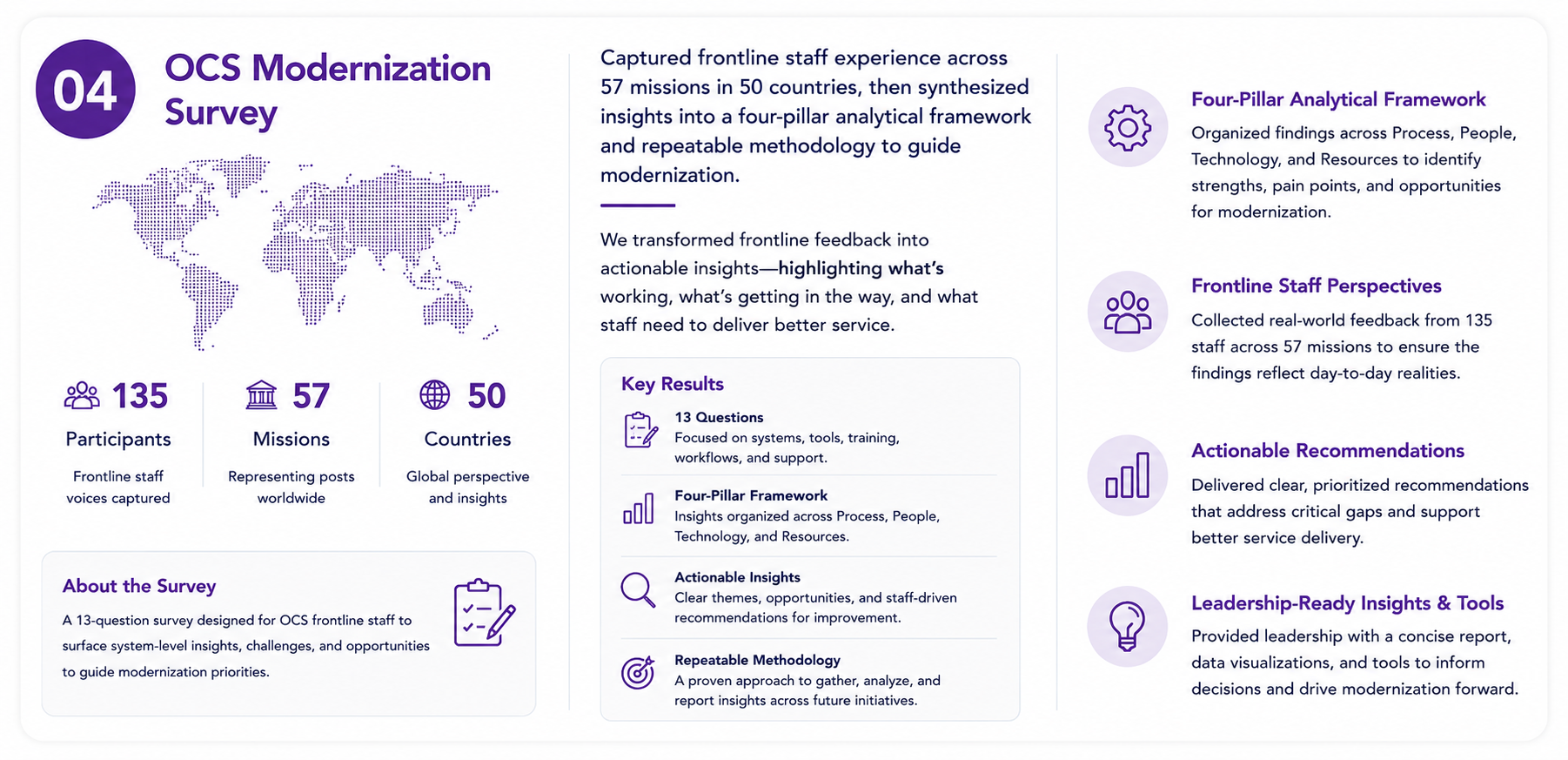
Synthesized 135 staff responses across 57 missions in 50 countries into a four-pillar analytical framework and repeatable synthesis methodology that translated frontline operational experience into leadership-ready modernization insights.
Reflection
Better public services depend on the people seeking help and the systems supporting them.
Working across Overseas Citizen Services reinforced how closely the public experience is connected to the systems operating behind it.
For families navigating international parental child abduction concerns, the challenge was finding clear, trustworthy information at moments when uncertainty and emotional stress could make even simple decisions difficult.
For consular employees, the challenge often involved navigating complex workflows, administrative requirements, and technology that shaped their ability to provide timely, effective assistance.
Although the four workstreams addressed different aspects of the service, they shared a central principle: meaningful improvement requires understanding both the people seeking assistance and those responsible for delivering it.
The engagement reinforced the value of combining research, content strategy, service design, and operational insight to make complicated systems more understandable and identify opportunities for improvement.
Ultimately, good service design is about more than improving what people see. It is about understanding and strengthening the conditions that make a service work.