CITY OF AUSTIN / SERVICE DESIGN & PUBLIC ENGAGEMENT
LAW ENFORCEMENT COMPLAINT PROCESS & OVERSIGHT
Making police complaint services more accessible, transparent, and responsive to community needs.
For a public accountability system to work, people must be able to access it, understand it, and trust that their concerns will be heard. In Austin, the police complaint process presented significant barriers for residents seeking to report concerns about law enforcement. Filing a complaint could involve navigating unfamiliar procedures, visiting government facilities, and sharing sensitive information with institutions that some community members already distrusted.
Working with the City of Austin's Service Design Lab, the Office of the Police Monitor, and Austin Tech Alliance, I led service design and research activities to better understand these barriers and identify opportunities to improve the complaint experience. The work connected community perspectives with the operational realities of complaint intake, investigation, oversight, and follow-up—helping make a complex accountability system more visible and accessible.
My Role: Lead Service Designer
Organization: City of Austin — Office of Design & Delivery
Partners: Office of the Police Monitor · Austin Tech Alliance
The Challenge
Making an accountability process accessible to the people it was intended to serve.
Austin's police complaint process was intended to provide residents with a way to report concerns about law enforcement. Yet the experience of filing a complaint could present barriers before someone even began.
Residents could encounter requirements to visit a particular government location, navigate identification and building-access procedures, or engage directly with institutions they might already distrust. For people concerned about safety, privacy, or potential repercussions, these conditions could discourage participation.
The Office of the Police Monitor recognized that barriers existed, but needed a clearer understanding of where they occurred and how the process could better support the community.
Our work focused on three questions:
Access: What prevented residents from initiating or completing a complaint?
Service delivery: How did complaint intake, processing, investigation, and follow-up operate across departments?
Improvement: Where could changes to communication, procedures, technology, and service delivery make the process more accessible and responsive?
The challenge was not simply to make submitting a complaint easier. It was to understand the entire service—from a resident's first attempt to seek help through the operational systems responsible for receiving and responding to their concerns.
Project History
On March 22, 2018, Austin City Council passed Resolution 20180322-047, directing the City Manager to examine evidence-based practices for improving the effectiveness, transparency, and efficiency of civilian police oversight.
The City established a 15-member Police Oversight Advisory Working Group, bringing together representatives from city departments, community organizations, and oversight agencies.
The Working Group examined oversight models from San Jose, Seattle, Minneapolis, New Orleans, and Denver. Its research drew on the 12 core elements of effective civilian oversight identified by the National Association for Civilian Oversight of Law Enforcement (NACOLE).
This broader policy and governance work helped establish the context for examining Austin's complaint process, identifying barriers to public participation, and developing recommendations that addressed both community needs and institutional accountability.
Research & Community Engagement
Understanding the complaint process through community perspectives, frontline experiences, and direct observation.
Improving the police complaint process required understanding more than what happened after someone submitted a report. We needed to learn how residents perceived the system, what might prevent them from using it, and how the organizations responsible for oversight experienced the work themselves.
Our research combined community engagement, surveys, contextual observation, and interviews with residents, stakeholders, and staff.
Listening to the Community
The broader police oversight initiative involved community representatives, oversight stakeholders, and an advisory process examining opportunities for reform.
Community meetings held at local libraries and neighborhood centers provided opportunities to hear different perspectives on accountability, transparency, and public trust.
A six-question survey distributed through the City of Austin's Speak Up platform received nearly 600 responses. The feedback revealed a range of experiences, concerns, and priorities, helping inform the questions we explored through more detailed research.


Community Participation & Advisory Governance
The Police Oversight Advisory Working Group also explored how community participation could become a more meaningful part of Austin's civilian police oversight system.
The group met weekly at community centers and libraries across Austin, bringing together perspectives on police accountability, public trust, and opportunities for reform.
One area of focus was the proposed creation of a Community Advisory Board representing Austin's diverse communities. The envisioned board would have a role beyond public consultation, with opportunities to recommend changes to police policies, training, discipline, community relations, and complaint procedures.
Proposed responsibilities also included reviewing certain closed Internal Affairs disciplinary cases and Travis County District Attorney declination letters to identify potential policy and training improvements.
These discussions recognized that an accessible complaint process was only one component of effective civilian oversight. Meaningful accountability also required considering how community perspectives could influence the policies and institutional decisions shaping the service.

Observing the Existing Experience
We conducted contextual observations and shadowing activities at the Office of the Police Monitor, examining scenarios involving a resident filing a complaint.
Observing the process in its actual service environment revealed barriers that might be overlooked when reviewing procedures alone: reaching the office, navigating building access and identification requirements, finding parking, and understanding how to begin the complaint process.
These observations helped us distinguish issues with the form itself from the broader physical, procedural, and environmental barriers surrounding the service.

Understanding Both Sides of the Service
The research included 21 interviews across eight stakeholder groups, including Office of the Police Monitor staff, Internal Affairs, police leadership, Equity Office staff, community members and advocates, former Community Review Panel members, and City Council representatives. This breadth helped us understand the complaint experience from both community and institutional perspectives.
Interviews took place in government offices, community centers, residents' homes, online, and other locations across Austin.We spoke with people encountering the complaint process as well as employees responsible for receiving, processing, and responding to complaints.Because conversations could involve fear, distrust, and potentially traumatic experiences, I developed adaptable interview guides and approached recruitment and facilitation with particular attention to participant well-being.
Bringing these perspectives together helped us understand the relationship between the public-facing experience and the policies, workflows, and organizational responsibilities operating behind it.
Conducting research in this environment also required careful planning. I developed a phased research schedule, coordinated recruitment across diverse participant groups, and tailored outreach to residents, community representatives, and law enforcement personnel. Interview guides used open-ended questions and adaptable prompts to accommodate different experiences while keeping the research focused.
The emotional demands of these conversations also required attention to researcher well-being and ethical boundaries. I established clear research goals and limits, monitored my own capacity, and balanced the need for actionable insights against the risk of asking participants to revisit distressing experiences unnecessarily. This reinforced an important lesson: responsible research considers the well-being of both participants and the people conducting it.
Identifying Patterns & Opportunities
Making the complaint process visible across people, departments, and service touchpoints.
After gathering feedback from residents, community representatives, and staff, we brought the research together to identify recurring patterns, barriers, and opportunities for improvement.
Through collaborative synthesis, we clustered observations and interview findings into themes that helped explain not only where people encountered difficulties, but how those difficulties related to the larger complaint system.
From Research to Service Understanding
The findings informed user stories, personas, and journey maps that represented different perspectives on the complaint experience.
These artifacts helped us examine what residents needed at each stage, where uncertainty or friction emerged, and how the process was experienced by employees responsible for receiving and responding to complaints.
Several important areas emerged for closer examination: physical access to complaint services, identification requirements, communication, transparency, and the ability to understand what happened after submitting a complaint.

Participant accounts illustrating barriers to physical access, language comprehension, complaint follow-up, and trust in the oversight process.
Connecting the Frontstage and Backstage
We translated the research into service blueprints that connected residents' experiences with the workflows, responsibilities, and organizational processes operating behind them.
Mapping these relationships made it easier to identify handoffs, gaps, and opportunities that could not be addressed by changing a form or interface alone.
The blueprints created a shared reference for discussing how policy, staff responsibilities, service channels, and technology influenced the overall experience.
Connecting Insights to Oversight Principles
To ensure recommendations were grounded in more than individual preferences, we also considered the 12 core elements of effective civilian oversight identified by the National Association for Civilian Oversight of Law Enforcement.
This helped connect community needs and operational findings with established principles of accountability, independence, accessibility, and transparency.
The result was a clearer foundation for moving from research insights toward practical service improvements.
Key Findings & Service Recommendations
Turning community research into practical improvements across complaint intake, communication, and civilian oversight.
The research revealed that improving access to the police complaint process required changes beyond the complaint form itself.
Barriers existed across physical locations, documentation requirements, communication, and the relationships between the community and oversight institutions. Addressing them meant considering both the resident experience and the policies and operational processes supporting it.
Improving the Complaint Experience
The research identified barriers that could discourage residents from filing complaints, including reliance on a single government location, identification requirements, limited communication, and uncertainty about how the process worked.
The Working Group developed six recommendations to make complaint services more accessible:
Expand access points. Make complaint intake forms available at locations throughout Austin rather than requiring residents to visit a single government office.
Provide multilingual digital intake. Develop an accessible online form allowing residents to submit complaints, compliments, and concerns directly.
Support community-based intake. Train community members on the complaint process and explore authorizing trusted community representatives to receive and forward complaints through partnerships with local organizations.
Improve communication and follow-up. Establish procedures for keeping complainants informed about the status and outcome of their submissions.
Remove unnecessary procedural barriers. Allow sworn and anonymous submissions without requiring a signed affidavit where legally permitted.
Strengthen community awareness. Provide training and outreach that help residents understand their options and access complaint services.
Together, these recommendations aimed to make the complaint process easier to access, understand, and navigate while reducing barriers that could prevent residents from participating in civilian police oversight.
Strengthening the Oversight System
The broader recommendations also addressed the institutional conditions shaping public trust.
These included securing stable funding to support oversight independence, strengthening community advisory participation, expanding public outreach, and improving transparency through reporting and accessible information about complaints and investigations.
Together, the recommendations recognized that public trust depends not only on how easily someone can submit a complaint, but also on whether the process is understandable, accountable, and responsive.
Informing Policy & Advocating for Resources
Turning research into meaningful change required more than identifying barriers and recommending solutions. Our team brought findings and recommendations to Austin City Council, advocating for policy and organizational changes that could strengthen civilian police oversight.
The work also included a proposed staffing model for the civilian oversight agency, outlining responsibilities across complaint monitoring, research and data analysis, policy development, community engagement, communications, and administrative support.
These efforts connected community research with the governance, staffing, and operational capacity needed to support a more accessible, independent, and accountable oversight system.
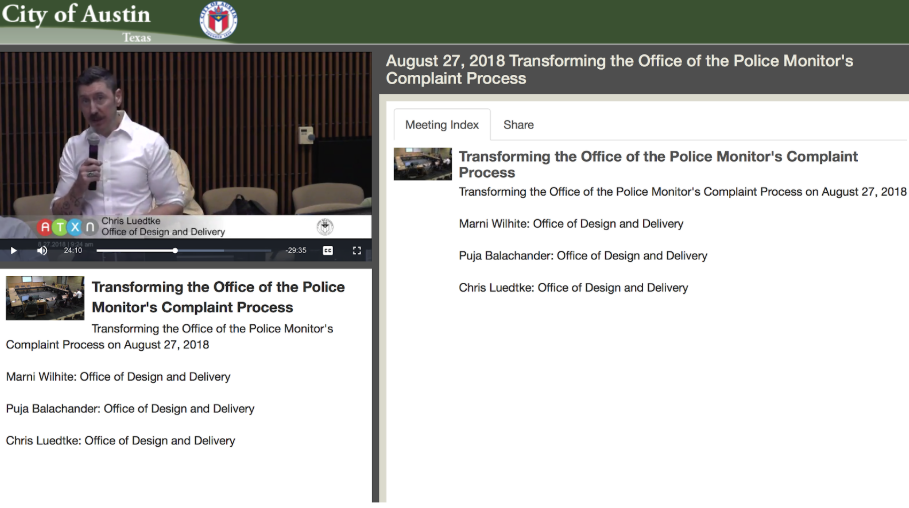
City of Austin Council presentation, August 27, 2018, sharing research findings and recommendations for transforming the Office of the Police Monitor’s complaint process.

Proposed staffing model for Austin’s civilian police oversight agency, outlining the roles, responsibilities, and coordination needed to support independent oversight, community engagement, research, and accountability.
Translating Recommendations into Service Design
We used service blueprints to connect identified barriers with the interactions, staff responsibilities, communication channels, and organizational processes behind them.
The blueprints traced the complaint experience from an initial encounter through intake, investigation, follow-up, and closure. By examining the public-facing and operational sides together, we could better understand where changes to procedures, technology, and communication might improve the service.
These artifacts helped translate research findings into concrete opportunities for service improvement and subsequent design work.
Service blueprint connecting the resident complaint journey with communication channels, staff responsibilities, backstage workflows, and opportunities for improving civilian police oversight.
Strengthening the Oversight System
The Working Group's recommendations also addressed the institutional conditions necessary for effective civilian oversight.
Proposals included establishing stable funding and independent legal support for the Office of the Police Monitor, periodically reviewing the effectiveness of the oversight system, and strengthening opportunities for community participation.
Recommendations also emphasized expanding public reporting on complaint activity, investigation outcomes, and patterns in police practices. A proposed online data portal would make oversight information more accessible and help residents understand how complaints were handled.
Community outreach was another priority, including stronger partnerships with local organizations, opportunities for public feedback, and consideration of a Community Advisory Board with a meaningful role in oversight recommendations.
Together, these proposals recognized that improving access to complaints was only one part of building a more transparent, accountable, and responsive oversight system.


From Recommendations to Design
Turning research findings into a more accessible complaint experience.
With research findings and service recommendations established, the next phase focused on translating those opportunities into practical improvements to the complaint intake experience.
The work moved from understanding barriers across the service to designing, testing, and refining ways for residents to access it.
Organizing Information Around Resident Needs
We conducted card-sorting activities to better understand how people grouped information, interpreted terminology, and expected to navigate the complaint process.
These findings informed the information architecture, helping us establish clearer content groupings, labels, and pathways for residents submitting complaints, compliments, or concerns.
The goal was to create an experience that reflected how residents understood the service rather than requiring them to understand its internal organizational structure.
Designing and Testing the Experience
The design process included early concept and A/B testing, followed by iterative usability testing of low- and high-fidelity prototypes. Feedback informed refinements to content, navigation, accessibility, and the mobile experience.
As the designs matured, I worked with front-end and back-end teams to evaluate technical feasibility, refine the experience, and develop detailed specifications that supported implementation. Repeated testing helped connect design decisions to observed user needs rather than relying on assumptions.
I developed wireframes and low-fidelity prototypes to explore how the complaint process could work through a more accessible digital channel.
Working collaboratively with front-end and back-end teams, we examined usability, technical feasibility, and how proposed interactions would connect with existing operational workflows.
The design process included concept evaluation, usability testing, and iterative refinement. Feedback helped inform the progression from early wireframes to high-fidelity prototypes, with particular attention to clarity, accessibility, and mobile use.
Supporting Implementation
As the design progressed, I worked with technical partners to help preserve design intent and address implementation considerations.
The work also involved advocating for the resources and organizational support needed to sustain improvements beyond the initial research and design phases.
This was an important part of the engagement: connecting research recommendations with the practical conditions required to deliver and maintain a public service.
The resulting work supported the development and launch of a revised online complaint intake experience, providing residents with an additional way to contact the oversight office.

Public-facing complaint intake experience developed through the City of Austin's Alpha website, emphasizing clear guidance and accessible reporting.
Office of Police Oversight digital service, showing complaint and compliment pathways and the mobile intake experience.
Launch & Early Results
Creating another pathway for community members to reach the oversight office.
The redesigned online intake experience provided residents with an additional channel for submitting complaints, compliments, and concerns about interactions with law enforcement.
Before the form's release, the Office of the Police Monitor received fewer than ten complaints per month on average, according to the project's reported figures.
During the first year following the online form's launch, the office reported an average of approximately 80 contacts per month, including 94 thank-you submissions over that period.
These figures represent different measures—complaint filings before launch and broader contact activity afterward—so they should not be interpreted as a direct comparison of complaint volume.
They do, however, document engagement with the expanded intake service.
The project also produced research findings, service blueprints, community-informed recommendations, and design artifacts that helped connect the resident experience with the operational responsibilities of civilian police oversight.
Together, the work established a more accessible digital pathway and provided a foundation for continued evaluation and service improvement.
Reflection
Making a service accessible requires understanding everything surrounding the point of entry.
This project reinforced that accessibility is not simply a property of a website or form. It is shaped by where a service is offered, the requirements people encounter, the information they receive, and the institutions they must engage with along the way.
For someone considering filing a complaint about law enforcement, those conditions can carry particular weight. Trust, safety, privacy, and the possibility of repercussions all influence whether a person feels able to participate.
The research also reminded me of the importance of understanding the experience of employees working within these systems. Making service processes visible helped connect community concerns with organizational responsibilities and the practical realities of delivering oversight services.
Moving from community research to recommendations, service blueprints, prototypes, and a launched digital intake experience demonstrated how service design can bring different perspectives together around opportunities for meaningful change.
The most important lesson was that improving a single interaction is only one part of improving a public service.
The larger responsibility is to understand the conditions that make participation possible—and identify where the system itself needs to change.
Further Reading
Explore the research and policy recommendations developed through the Police Oversight Advisory Working Group.
Police Oversight Advisory Working Group-Final Recommendations